New research suggests that the biggest barriers are no longer technological.
For years, discussions around bio-based construction materials focused on one question: Can they really compete with conventional materials?
Today, the answer is increasingly yes.
Engineered timber, wood fibre insulation, cellulose insulation, bio-based polyurethanes and many other renewable materials have already demonstrated their technical performance in real construction applications. Yet despite growing scientific evidence and increasing political support, they still represent only a small share of the European construction market.
So, what is preventing their wider adoption?
A recently published scientific review in the journal Resources argues that the answer has changed. According to the authors, the main challenge is no longer innovation itself, it is creating the conditions for innovation to reach the market.
The technology is ready but the system isn’t
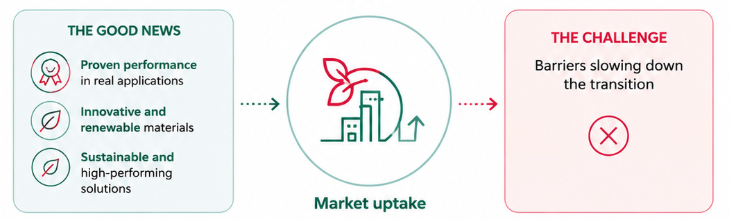
For many years, research efforts focused on proving that bio-based materials could deliver the required mechanical, thermal and environmental performance. Today, many of these technologies have reached a high level of maturity. The review highlights that for well-established materials such as engineered wood products, cellulose insulation or cork-based solutions, the technical case is largely proven.
Instead, the authors identity a different set of obstacles that continue to slow down market uptake.
Four barriers slowing down the transition
Rather than focusing on material performance, the review identitifes four interconnected challenges:
1.A fragmented regulatory framework
One of the biggest barriers remains the lack of harmonised European standards for many bio-based construction materials.
Different certification procedures between Member States increase costs for manufacturers and make it difficult to commercialise innovative products across Europe.
2. Market conditions still favor conventional materials
Many environmental costs associated with traditional construction materials are not fully reflected in their market price.
At the same time, bio-based solution often face higher production costs due to limited industrial scale and developing supply chains.
As a result, innovative materials must compete in a market that does not yet fully reward their environmental benefits
3. Supply chains need to scale up
Producing bio-based materials requires reliable access to renewable feedstocks, industrial processing capacity and stable demand.
The review highlights that many value chains remain fragmented, making large-scale deployment more difficult than the technology itself.
4. Confidence remains a challenge
Even when innovative materials perform well, architects, engineers, insurers and public procurers often prefer familial solutions.
Building trust requires long-term performance data, harmonised standards and successful demonstration projects capable of recuding perceived risk.
Sustainability is no longer the only driver

One of the most interesting conclusions of the review is that bio-based materials should no longer be viewed only through the lens of climate change.
Recent geopolitical events have exposed Europe’s dependence on fossil-derived raw materials and complex international supply chains.
Disruptions affecting energy and petrochemical markets have highlighted how vulnerable the construction sector remains to external shocks.
In this context, developing European bio-based value chains is becoming not only and environmental objective, but also an industrial and strategic one.
Bio-based construction materials can contribute simultaneously to reducing greenhouse gas emissions, trenghtening European industrial resilience and improving long-term supply security.
From research to market deployment
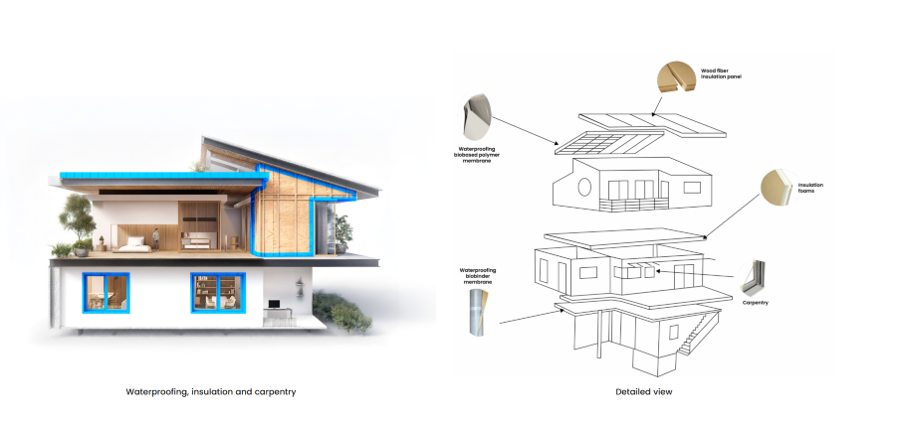
This evolution marks an important dhift in the bio-based construction sector. The challenge is no longer simply to invent better materials. The next step is ensuring that regulations, certification systems, industrial production and market conditions evolve quickly enough to allow these innovations to become mainstream.
Projects such as HIBISCUS contribute to this transition by supporting the development and industrial validation of next-generation bio-based solutions for the building envlope. Beyond developing innovative materials, the project also addresses key aspects highlighted in the review, including durability, environmental performance, circularity and the Safe and Sustainable by Design (SSbD) approach, all essential elements for accelerating future market uptake.
Want to learn more?
This article is inspired by the scientific review:
Pacheco Torgal, Fernando. 2026. “Bio-Based Construction Materials in the Context of the EU Bioeconomy: Overcoming Systemic Barriers to Mainstream Adoption” Resources 15, no. 6: 72. https://doi.org/10.3390/resources15060072