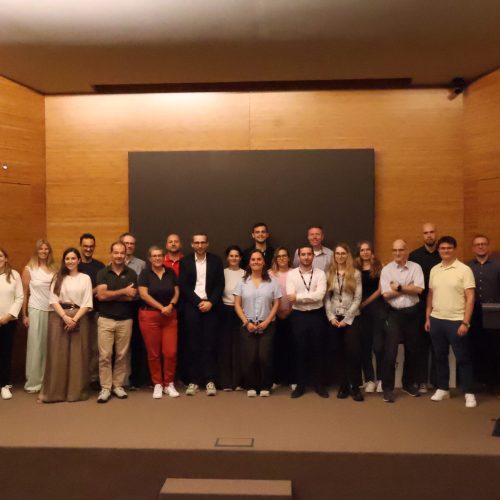
On 30 September and 1 October 2026, the HIBISCUS consortium gathered in Barcelona, Spain, for its second Steering Committee meeting. The two-day event brought partners together to review the project’s first year of progress, exchange on technical developments and sustainability challenges, and discover innovative technologies through visits to LEITAT and INDRESMAT.
One year after the project’s launch in Strasbourg last year, the Barcelona meeting provided an important opportunity to assess the first results, strengthen collaboration between partners and prepare the next stages of development.
From renewable feedstocks to innovative construction materials: first technical achievements
Throughout the Steering Committee, partners presented progress across the different stages of the HIBISCUS value chain, from renewable raw materials and polymer development to functional additives and final construction applications.
Several areas of technical progress were highlighted during the meeting:
- Renewable feedstock transformation: Progress in the valorisation of used cooking oil and lignin into bio-based building blocks for polymer production, alongside ongoing research on tall oil pitch modification for waterproofing applications.
- Bio-based polymers and insulation materials: Advances in the development of thermoplastic polyurethanes (TPUs), non-isocyanate polyurethane (NIPU) foams and bio-based polyurethane formulations for insulation and carpentry applications.
- Functional additives: Ongoing work on lignin-based flame retardants, bio-based adhesives and protective coatings, with a focus on improving the functional properties of construction materials.
- Construction product performance: Progress in defining characterisation and durability assessment approaches, including ageing, moisture resistance and long-term material performance.
- Scale-up and demonstration: Initial preparations for the transition from laboratory-scale developments towards pilot manufacturing and the project’s targeted construction demonstrators.
These activities illustrate the progress made across the HIBISCUS value chain during its first year, from renewable raw materials to the development of high-performance construction products. The discussions also highlighted the importance of close collaboration between partners to ensure that the materials developed meet the technical, industrial and sustainability requirements of their intended applications.
Integrating safety and sustainability from the beginning
Beyond technical developments, the Steering Committee dedicated a specific workshop to the project’s Safe and Sustainable by Design (SSbD) approach, led by ifeu, the partner responsible for the integrated sustainability and safety assessment.
The workshop brought partners together to discuss how environmental, economic, social and safety considerations can be integrated throughout the development of HIBISCUS materials. Particular attention was given to defining the project’s value chains and identifying relevant scenarios for comparing the innovative bio-based solutions with conventional construction products.
Discussions also explored key sustainability challenges, including the sourcing and availability of renewable feedstocks, the environmental implications of different supply chains, and opportunities for recycling and end-of-life management. Partners highlighted the importance of considering the entire product life cycle, from raw material production to use and disposal, to ensure a comprehensive assessment of the developed solutions.
Through this collaborative approach, HIBISCUS aims to identify potential environmental benefits, trade-offs and opportunities for improvement, while ensuring that sustainability claims are supported by robust scientific evidence.
The outcomes of the workshop will help shape the project’s upcoming sustainability assessments and guide the development of construction materials that combine technical performance, safety and circularity.
Exploring innovation in practice: visits to LEITAT and INDRESMAT
The Barcelona meeting also offered consortium members the opportunity to discover the facilities and expertise of two organisations involved in the development of innovative materials.
Discovering LEITAT’s research and innovation facilities
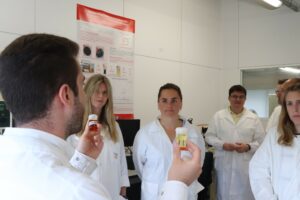
During the visit to LEITAT, partners had the opportunity to explore the research centre’s facilities and learn more about its expertise in applied research, materials development and industrial innovation.
As a HIBISCUS partner and leader of the work on bio-based feedstock transformation, LEITAT plays a key role in converting renewable resources, including used cooking oil, into valuable building blocks for the development of sustainable construction materials.
The visit provided an opportunity to connect the project’s technical activities with the research facilities and expertise supporting their development, while encouraging exchanges between consortium members.
Visiting INDRESMAT: innovation in insulation materials
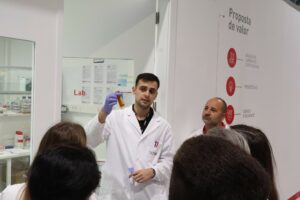
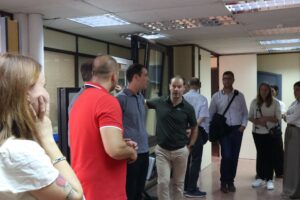
The consortium also visited INDRESMAT, an innovative company developing sustainable, bio-based solutions for the construction sector, with a particular focus on window and door systems. The visit gave partners the opportunity to learn more about the company’s technologies and approach to replacing conventional building materials with more sustainable alternatives. It also provided valuable opportunities to exchange views on material performance, industrial development and the challenges of bringing innovative bio-based construction products to market.
Building on the first year and preparing the next steps
Following its first year of implementation, HIBISCUS is now entering a new phase focused on optimising bio-based materials, advancing their characterisation and preparing for pilot-scale manufacturing and demonstration.
Over the coming months, partners will continue refining polymer formulations and functional additives, while assessing the performance, durability and suitability of the developed materials for their intended construction applications. In parallel, preparations for scale-up and demonstrator manufacturing will progress, supported by ongoing sustainability and safety assessments.
The Barcelona Steering Committee provided a valuable opportunity to align these next steps, address common technical challenges and strengthen collaboration across the consortium.
A warm thank you to LEITAT and INDRESMAT for welcoming the consortium, to SOPREMA for coordinating the meeting, and to all HIBISCUS partners for their contributions and active participation!
Stay tuned for more updates as HIBISCUS continues its journey towards high-performance, circular and bio-based solutions for a more sustainable construction sector.