Insulation makes buildings more comfortable and energy-efficient, but its environmental performance depends on more than what happens after installation. Buildings and construction account for around 32% of global energy demand and 34% of global CO₂ emissions[1]. Insulation can reduce the energy needed for heating and cooling, but producing an insulation material also requires raw materials, energy, transport and additives, and eventually raises questions about reuse, recycling or disposal.
So how can we look at the full environmental footprint of insulation? And can bio-based materials provide an alternative? These are questions being explored within HIBISCUS, where two of the project’s five building products specifically address insulation: bio-based non-isocyanate polyurethane foams and wood-fibre insulation panels.
What does an insulation material do?
An insulation material slows heat transfer through walls, roofs and floors. Its effectiveness is mainly measured through thermal conductivity: the lower the value, the better it limits heat transfer. Thickness, density, moisture behaviour and installation quality also matter.
In winter, insulation retains warmth; in summer, it limits incoming heat. Its position also matters: modelling of different insulation materials across different wall types showed that external insulation generally delivered the best thermal results. Compatibility with the wall is equally important for managing heat and moisture together.[2]
Looking beyond energy savings
Before reaching a wall, insulation passes through several stages. Raw materials are extracted or cultivated, processed, combined and transported. After use, the product may be reused, recycled, incinerated or disposed of.
A life-cycle assessment considers this complete journey, including:
- raw-material sourcing
- energy and water used in manufacturing
- transport and installation
- performance and durability during use
- reuse, recycling and end-of-life treatment
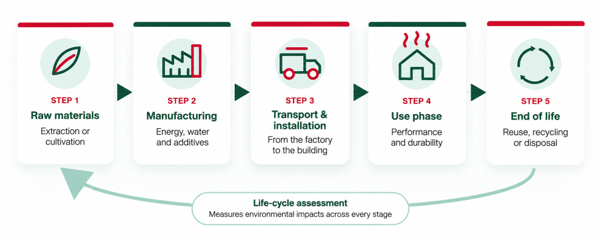
In HIBISCUS, project partner IFEU will use this life-cycle approach to assess a range of environmental impacts, going beyond carbon emissions to consider aspects such as resource use, water consumption and pollution. This helps provide a more complete picture of the environmental footprint of building materials.
Composition still matters. Many conventional insulation materials (both foams and fibrous materials) rely on fossil resources as their main material or for their binders, flame retardants and moisture or mould treatments. These additives provide strength, safety and durability, but small quantities can strongly influence the recyclability and the footprint
This is why improving insulation also requires rethinking the less visible components that make the final product safe, durable and effective.
Bio-based insulation and the HIBISCUS approach
Bio-based insulation offers a promising way to reduce dependence on fossil resources. Hemp, flax, cork, cellulose and wood fibre come from renewable sources and can store carbon absorbed by plants during growth throughout the material’s use. The climate benefit of this storage, however, depends on factors such as the duration of storage and the material’s end-of-life[3]. Some bio-based insulation materials can achieve thermal performance comparable to conventional products, depending on factors such as their composition, density and thickness. Their ability to absorb and release moisture can also contribute to indoor comfort.
Research also shows that the performance of bio-based insulation can be adjusted through material design: density influences thermal insulation, while thickness and density can affect sound absorption[4].
Their environmental potential can be strengthened further by:
- using agricultural residues and industrial side streams
- replacing fossil-based adhesives and additives
- improving durability and recyclability
- assessing impacts across the complete life cycle
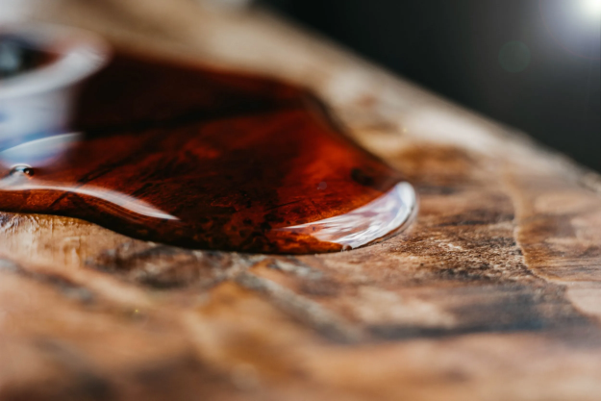
Building on these developments, HIBISCUS is developing two insulation solutions that combine high bio-based content with thermal performance, fire safety and long-term durability.
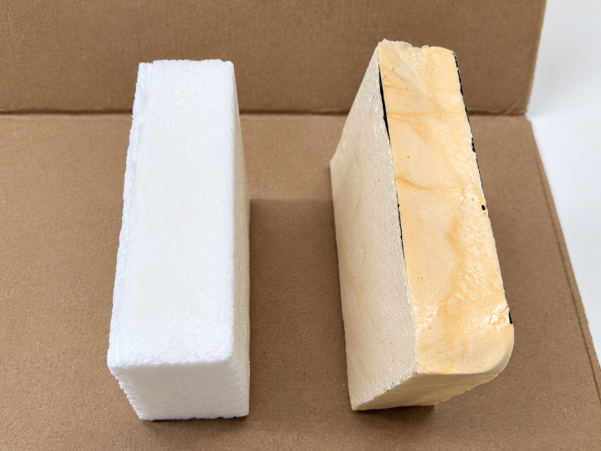
Bio-based non-isocyanate polyurethane foams
Polyurethane foams are widely used for building insulation. Conventional production relies on highly reactive chemicals called isocyanates; HIBISCUS is exploring an alternative route that avoids their use while incorporating renewable raw materials.
HIBISCUS aims to develop lightweight, closed-cell and isocyanate-free foams containing at least 60% bio-based material, with some formulations expected to reach more than 90%.
One of the key challenges faced by ULiège in the development of these isocyanate-free insulating foams is achieving, through its green chemistry approach, a formulation capable of reaching foaming rates compatible with industrial panel manufacturing processes. In conventional polyurethane (PU) foams, the rapid foaming kinetics are largely driven by the high reactivity of isocyanates. Reproducing such processing speeds without the use of isocyanates therefore represents a major scientific and technological challenge
– Laetitia Urbanczyk & Christophe Detrembleur, ULiège
This work brings together the University of Liège for foam development, CellMat for characterisation and optimisation, VITO for lignin-based flame retardants, SOPREMA for thermal testing and pilot production, and CSTB for fire performance assessment.
Wood-fibre insulation panels
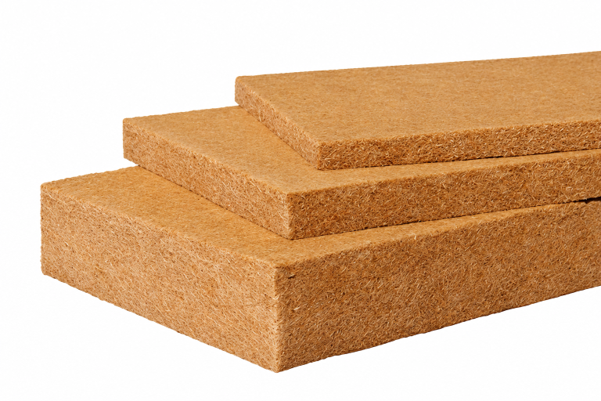
Wood-fibre insulation may sound entirely bio-based, but conventional panels can still rely on fossil-based additives such as adhesives and flame retardants. Current products can reach up to 90% bio-based content, but these remaining components are more difficult to replace. The project aims to go a step further by developing 100% bio-based thermo-acoustic wood-fibre insulation, replacing these remaining fossil-based components with bio-based alternatives. These include adhesives derived from agricultural residues and side streams, lignin-based flame retardants and a chitosan-based treatment to limit mould growth.
The development of the wood-fibre insulation panels involves SOPREMA for adhesive development and panel production, CNRS for adhesive characterisation, VITO for lignin-based fire protection, and CSTB for bio-based mould treatment.
Both solutions will be tested for thermal performance, fire safety, moisture behaviour, durability and recyclability. HIBISCUS plans to produce around 3 m³ of NIPU foam and 20 m³ of wood-fibre insulation panels to demonstrate that these solutions can move beyond laboratory scale.
Assessing environmental performance across the whole life cycle
Developing a bio-based material does not automatically guarantee a lower environmental footprint. To find out, project partner IFEU will carry out a Life Cycle Assessment (LCA) following the ISO 14040 and ISO 14044 framework[5]. The assessment will look at the materials from cradle to grave, from raw materials and manufacturing through to their use and eventual end-of-life.
The HIBISCUS solutions will then be compared with conventional products providing the same function: standard polyurethane insulation panels for the NIPU foams and standard wood-fibre panels for the new bio-based panels. This will help identify where the new solutions offer environmental benefits, where trade-offs may occur and where further improvements are needed.
By connecting bio-based ingredients, product development, pilot production and full life-cycle assessment, HIBISCUS aims to determine whether these promising insulation technologies can deliver environmental benefits while meeting the requirements of real building applications.
The goal is not simply to replace fossil-based ingredients with renewable ones, but to understand whether these alternatives can perform well while reducing impacts across their entire life cycle.
Sources and further reading
Grant Agreement: Project 101214084 – HIBISCUS. (2025) Horizon Europe, call HORIZON-JU-CBE-2024. (Confidential)
Dickson, T., & Pavía, S. (2021). Energy performance, environmental impact and cost of a range of insulation materials. Renewable and Sustainable Energy Reviews, 140, 110752. https://doi.org/10.1016/j.rser.2021.110752
Pacheco-Torgal, F. (2026). Bio-based construction materials in the context of the EU bioeconomy: Overcoming systemic barriers to mainstream adoption. Resources, 15(6), 72. https://doi.org/10.3390/resources15060072
United Nations Environment Programme (UNEP) & Global Alliance for Buildings and Construction (GlobalABC). (2025). Global Status Report for Buildings and Construction 2024–2025: Not Just Another Brick in the Wall. https://wedocs.unep.org/items/cd45bf5e-f635-4b6e-a453-8de0433aef35
European Commission, Directorate-General for Climate Action. (2026). Carbon Removals and Carbon Farming – Certification methodologies: Carbon storage in products. Updated 10 June 2026. https://climate.ec.europa.eu/areas-action/carbon-removals-and-carbon-farming/certification-methodologies_en
IFEU. (2026). HIBISCUS WP7 – Integrated Sustainability and Safety Assessment: SSbD Workshop. HIBISCUS Steering Committee No. 2, Barcelona, 1 October 2026. Internal project presentation. (Confidential)
Ye, F., Wei, H., Xiao, Y., Berardi, U., Quaranta, G., & Demartino, C. (2025). Bio-based insulation materials in sustainable constructions: A review of environmental, thermal and acoustic insulation, durability, and mechanical performances. Renewable and Sustainable Energy Reviews, 223, 115872. https://doi.org/10.1016/j.rser.2025.115872
[1] United Nations Environment Programme (UNEP) & Global Alliance for Buildings and Construction (GlobalABC), Global Status Report for Buildings and Construction 2024–2025: Not Just Another Brick in the Wall, 2025. https://wedocs.unep.org/items/cd45bf5e-f635-4b6e-a453-8de0433aef35
[2] Dickson, T., & Pavía, S. (2021). Energy performance, environmental impact and cost of a range of insulation materials. Renewable and Sustainable Energy Reviews, 140, 110752. https://doi.org/10.1016/j.rser.2021.110752
[3] European Commission, DG Climate Action, Carbon Removals and Carbon Farming – Certification methodologies: Carbon storage in products, updated 10 June 2026. https://climate.ec.europa.eu/areas-action/carbon-removals-and-carbon-farming/certification-methodologies_en
[4] Ye, F., Wei, H., Xiao, Y., Berardi, U., Quaranta, G., & Demartino, C. (2025). Bio-based insulation materials in sustainable constructions: A review of environmental, thermal and acoustic insulation, durability, and mechanical performances. Renewable and Sustainable Energy Reviews, 223, 115872. https://doi.org/10.1016/j.rser.2025.115872
[5] IFEU. (2026). HIBISCUS WP7 – Integrated Sustainability and Safety Assessment: SSbD Workshop. HIBISCUS Steering Committee No. 2, Barcelona, 1 October 2026. Internal project presentation.